
Water Damage Restoration in Palm Beach Gardens
Water damage restoration Palm Beach Gardens residents search for is a master-planned, slab-on-grade, gated-community question. Palm Beach Gardens is the affluent suburban city north of West Palm Beach built around golf — PGA National and a constellation of gated communities of single-family homes, townhomes, and condos wrapped in golf courses, lakes, and preserve, on flat inland land. The losses here are suburban and seasonal: burst supply lines and water heaters, the A/C condensate overflows common to every South Florida home, lake-and-rain flooding of low terrain, and the summer mold that grows when seasonal owners leave with the air conditioning off. Restoration Doctor of West Palm Beach dispatches to the Gardens 24/7 at (888) 293-5663.
The defining fact of a Palm Beach Gardens water loss is the slab, and the defining complications are the community and the season. Homes are concrete block on poured slab — tile or wood over concrete, no basement — so water hides beneath the flooring, and the gated, association-run layout plus a large seasonal-resident population shape access and the summer A/C-shutoff mold pattern.
We treat a Gardens loss as a slab-drying problem with community coordination — verify moisture at the slab, assess the A/C, and work smoothly with associations and absent owners. Here is how the city's construction, seasonal occupancy, and flat inland terrain shape restoration.
How we dry Palm Beach Gardens properties
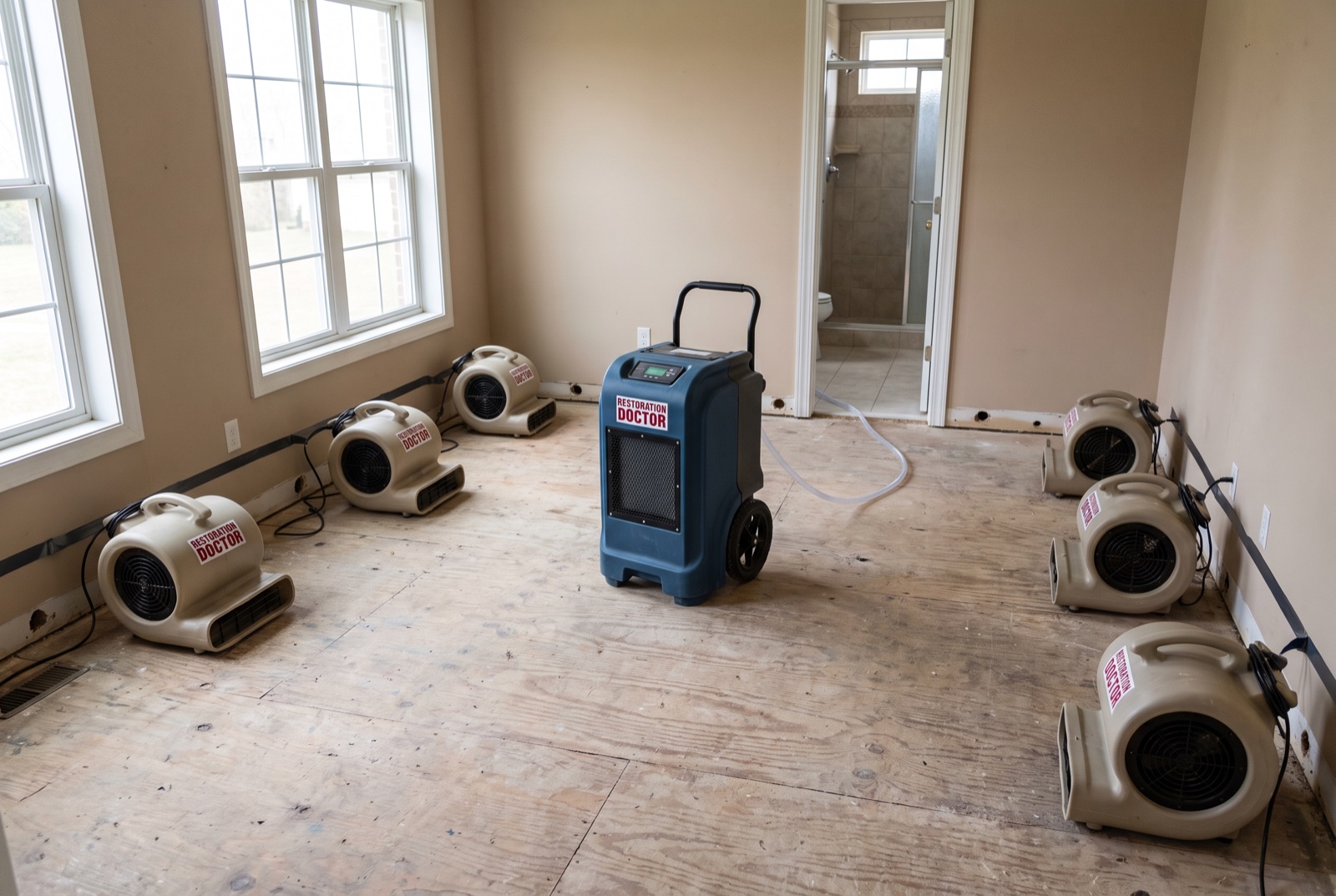
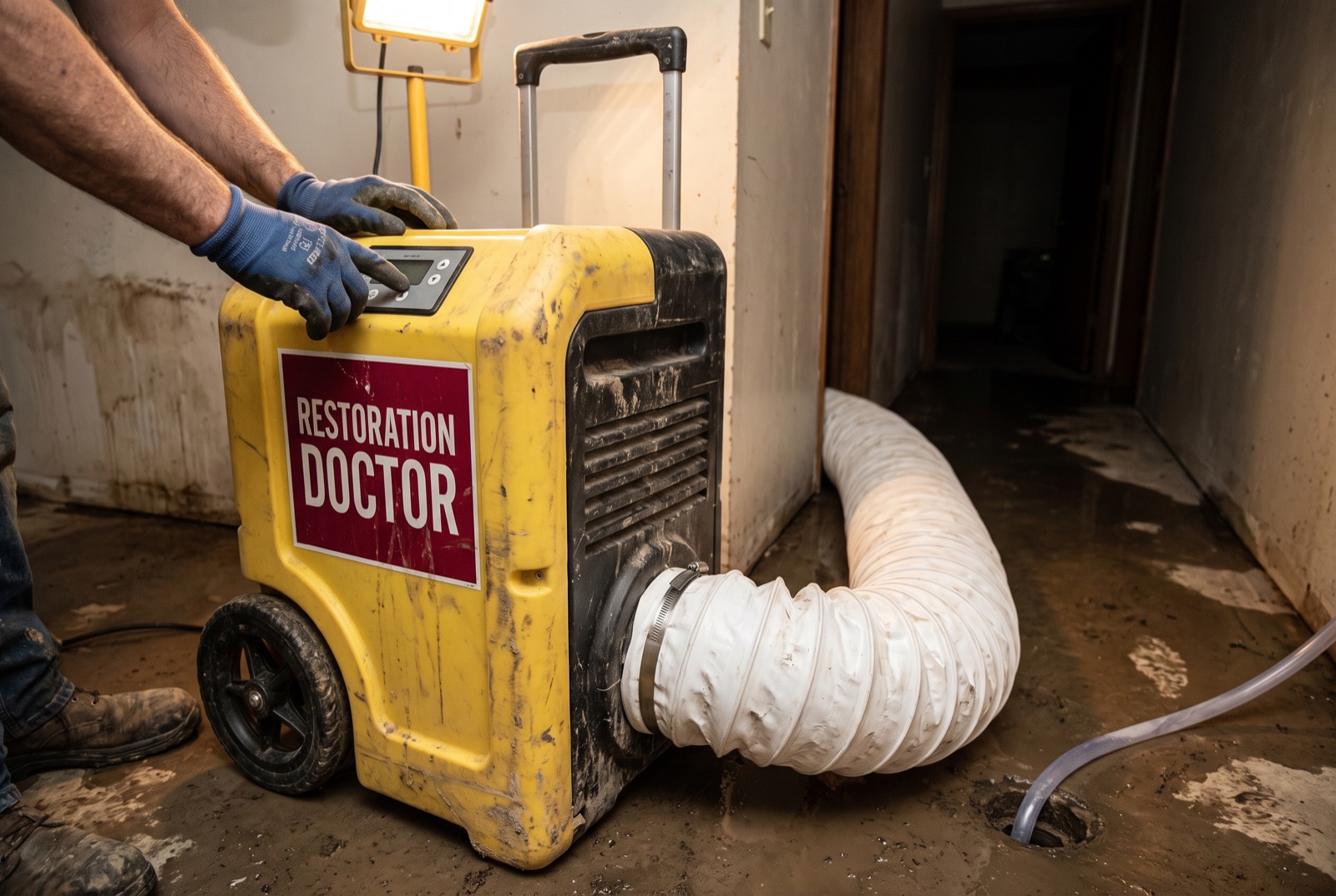
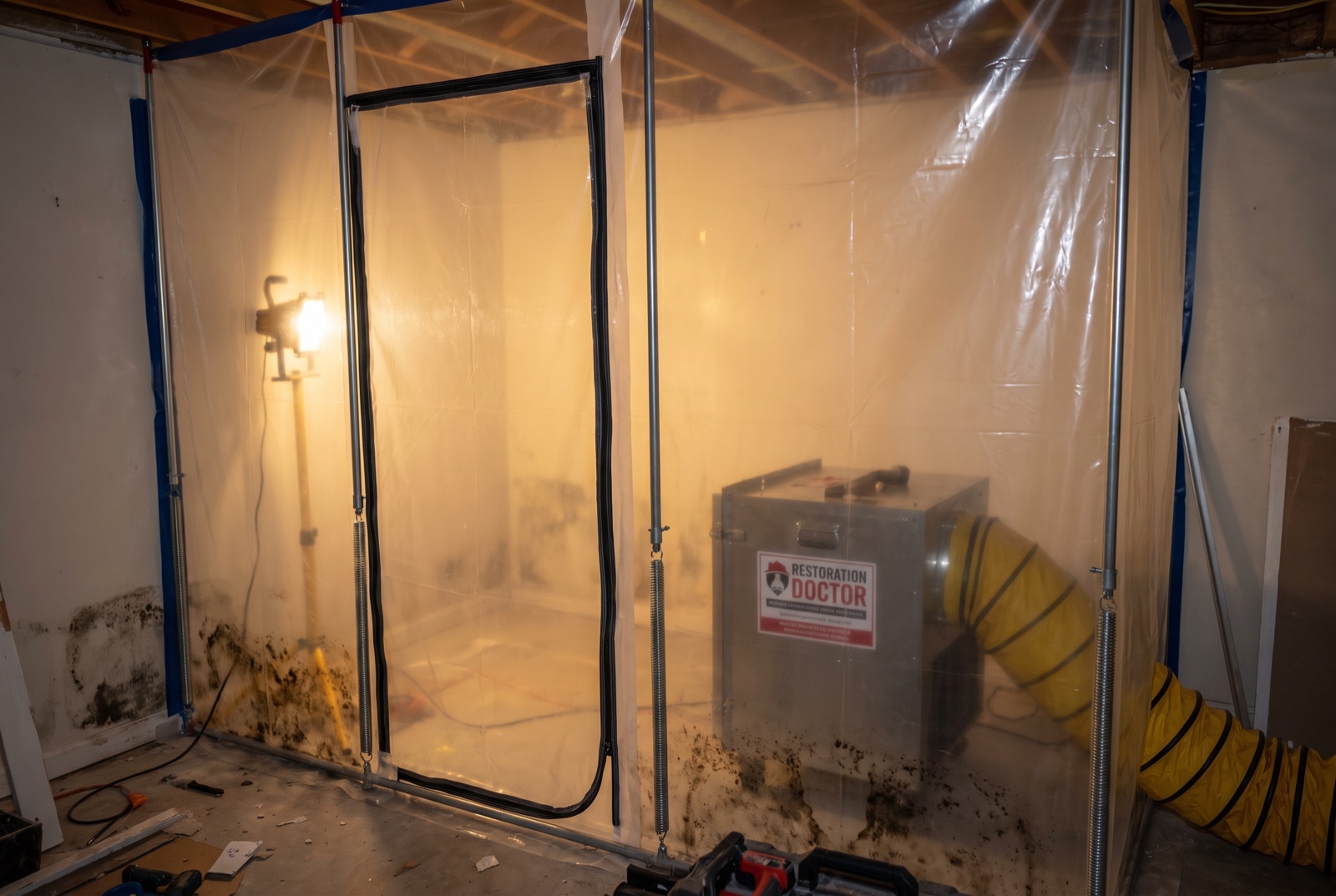
Illustrative views of the equipment and process our crews deploy — extraction, air movers, LGR dehumidification, moisture mapping, and containment.
How water damage behaves in Palm Beach Gardens
Tile-on-slab and the hidden lateral loss
The signature Palm Beach Gardens interior loss is water spreading unseen beneath a hard floor. A supply line, water heater, or appliance hose lets go, the water runs sideways under the tile or wood across the slab, and it wicks up into the block and drywall — so the visible wet area badly understates the real one. Surface-dry flooring routinely sits over a slab holding moisture for a week or more, and calling that dry leaves the wall bases to feed mold behind the baseboards.
We map the real extent with moisture meters and thermal imaging at the slab and wall bases, then build a drying system sized to it, using mat systems for tile or wood over slab where the numbers justify saving the floor and drying to documented targets confirmed by daily readings. In townhomes and coach homes we also check whether a loss has migrated through shared walls and document each unit separately.
A/C condensate and the summer-shutoff mold pattern
A large share of Gardens water and mold losses were never a plumbing leak at all — they were the air conditioning. Condensate lines clog with algae and overflow into ceilings, closets, and wall cavities, and seasonal homes closed up with the A/C off or set too high let interior humidity climb until mold grows on surfaces that were never wet from a leak. In South Florida's climate the mold clock is short, so we start drying immediately and, on mold projects, always evaluate the HVAC system — handler, condensate path, and accessible ducts — because a contaminated air handler re-seeds every room it serves.
Remediation follows IICRC S520 with containment and physical removal, and we document the moisture source so the fix is permanent. We counsel seasonal owners never to fully shut off climate control in a vacant home — a humidistat or a modest thermostat setting costs a fraction of a remediation.
Lakes, rain, coordination, and the owner's authority
The Gardens' lake-lined, flat terrain adds outside water. Perimeter and low-lying homes face lake and drainage flooding when intense rain overwhelms a community's stormwater system, and that flood water is contaminated under IICRC S500 — extracted, with unsalvageable porous material removed and surfaces disinfected. Rising water is generally excluded from standard policies and covered, if at all, under separate flood insurance; policies vary and we make no promises, but we document the entry path so the loss is classified from evidence.
The gated, association-run settings mean we coordinate access and any common-area work with community management, and we document everything for out-of-state owners managing a claim remotely. The decision to begin is yours: as the property owner you choose your restoration contractor and can start emergency mitigation to stop ongoing damage without a carrier's or association's pre-approval. We work for you, not the insurance company — we start on your authorization and hand you the carrier-ready claim file.
Palm Beach Gardens homes and how they fail
Palm Beach Gardens is newer and slab-built: concrete-block single-family homes, townhomes, coach homes, and mid-rise condos from the 1980s onward, arranged in gated golf communities like PGA National, BallenIsles, Mirasol, and Frenchman's Creek, plus non-gated subdivisions. Tile, wood, or laminate over poured slab is the norm, with no basement or crawlspace, so water that hits the floor travels sideways under the flooring and wicks up into the block and drywall. Our drying targets wall bases, cavities, and cabinetry, verified with meters rather than the visible waterline. Attached homes add shared-wall exposure.
Seasonal occupancy shapes the losses. Many Gardens homes are second homes closed up from spring through fall, and a home left without active cooling in a South Florida summer climbs past the humidity threshold where mold grows on contents and surfaces with no leak at all. The lake-lined, flat communities add drainage and perimeter-flooding exposure, and the active associations mean access and common-area coordination are part of many losses.
Palm Beach Gardens neighborhoods we serve
Real Palm Beach County communities — and the water losses we most often see in each.
Gated golf community of block-on-slab homes and condos where tile-on-slab hides lateral water and summer shutoffs breed mold.
Gated estate and villa communities where A/C condensate and slab losses recur among seasonal residents.
Waterfront and lakefront gated homes with drainage and perimeter-flooding exposure.
Established block-on-slab neighborhoods where aging supply lines, water heaters, and A/C drive interior losses.
Mid-rise condos where riser and A/C losses combine with association coordination.
Full restoration services in Palm Beach Gardens
One operation covers every category — from emergency mitigation to full reconstruction.
Water Damage Restoration
Extraction, structural drying, and moisture verification for pipe failures, king-tide intrusion, and unit-to-unit leaks in West Palm Beach homes, condos, and canal-front properties.
Storm & Hurricane Damage Restoration
Emergency board-up, tarping, storm-surge and flood extraction, and post-hurricane structural drying for homes, canal properties, and condo towers across West Palm Beach and Palm Beach County.
Mold Remediation
S520-based mold remediation: containment, HEPA-filtered removal, moisture-source correction, and post-remediation verification for West Palm Beach homes, condos, and waterfront properties.
Sewage Cleanup
Category 3 water mitigation: sewage extraction, contaminated material removal, disinfection, and structural drying for backups, drain failures, and tidal surcharge in Palm Beach County.
Fire & Smoke Damage Restoration
Structure securing, soot and smoke residue removal, odor treatment, and combined fire-and-water mitigation for West Palm Beach and Palm Beach County properties.
Contents Restoration & Pack-Out
Full-chain contents handling for Palm Beach County: barcode-tracked inventory, pack-out, restoration cleaning, climate-controlled storage, and organized pack-back.
What Palm Beach Gardens homeowners look for
Gardens owners, many managing a home from out of state, are right to distrust ratings a company writes about itself. Ours are not self-reported: verified customer reviews for the Restoration Doctor operation are hosted at RestorationDoctorsReviews.com, linked to the genuine Google source rather than pasted onto this page.
Judge the record yourself, then call (888) 293-5663 when water — or summer mold — hits your Palm Beach Gardens home.
Frequently asked
Active water, mold, fire, or sewage event?
Connect directly with the Restoration Doctor team for your region. Crews are on standby 24/7 with documented response protocols.